
Knowledge Nation Law Centre
Time management is one of the most critical factors in cracking the CLAT exam. Many students have strong conceptual knowledge but fail to achieve a high score due to poor time allocation and lack of speed. Since CLAT is a time-bound exam with passage-based questions, managing time effectively can significantly improve accuracy, attempt rate, and overall performance.
This detailed guide explains the best time management tips for CLAT exam, including section-wise strategy, mock test techniques, daily routine planning, and proven methods to improve speed and efficiency.
Understanding the Importance of Time Management in CLAT
The CLAT exam is designed to test not only knowledge but also how efficiently a student can process information under pressure. With multiple passages and a limited time frame, students must balance speed with accuracy.
Poor time management often leads to:
- Incomplete paper attempts
- Panic during the exam
- Lower accuracy due to rushed answers
- Poor section-wise performance
Effective time management ensures that you attempt maximum questions with high accuracy.
Keywords: time management for CLAT, CLAT exam strategy, CLAT preparation tips, speed and accuracy CLAT
CLAT Exam Structure and Time Challenge
CLAT is a two-hour exam consisting of passage-based questions from multiple sections. Each section requires careful reading, analysis, and logical reasoning.
Sections to Manage
- English Language
- Current Affairs and GK
- Legal Reasoning
- Logical Reasoning
- Quantitative Techniques
The biggest challenge is handling long passages within limited time while maintaining comprehension and accuracy.
Keywords: CLAT exam pattern, CLAT sections time distribution, CLAT time strategy
Ideal Time Allocation for Each Section
While the exact distribution may vary depending on strengths, a balanced approach is essential.
- English Language: 20–25 minutes
- Current Affairs and GK: 10–15 minutes
- Legal Reasoning: 35–40 minutes
- Logical Reasoning: 25–30 minutes
- Quantitative Techniques: 10–15 minutes
This structure ensures that no section consumes excessive time and allows for full paper coverage.
Keywords: CLAT section timing, time allocation CLAT, CLAT exam time distribution
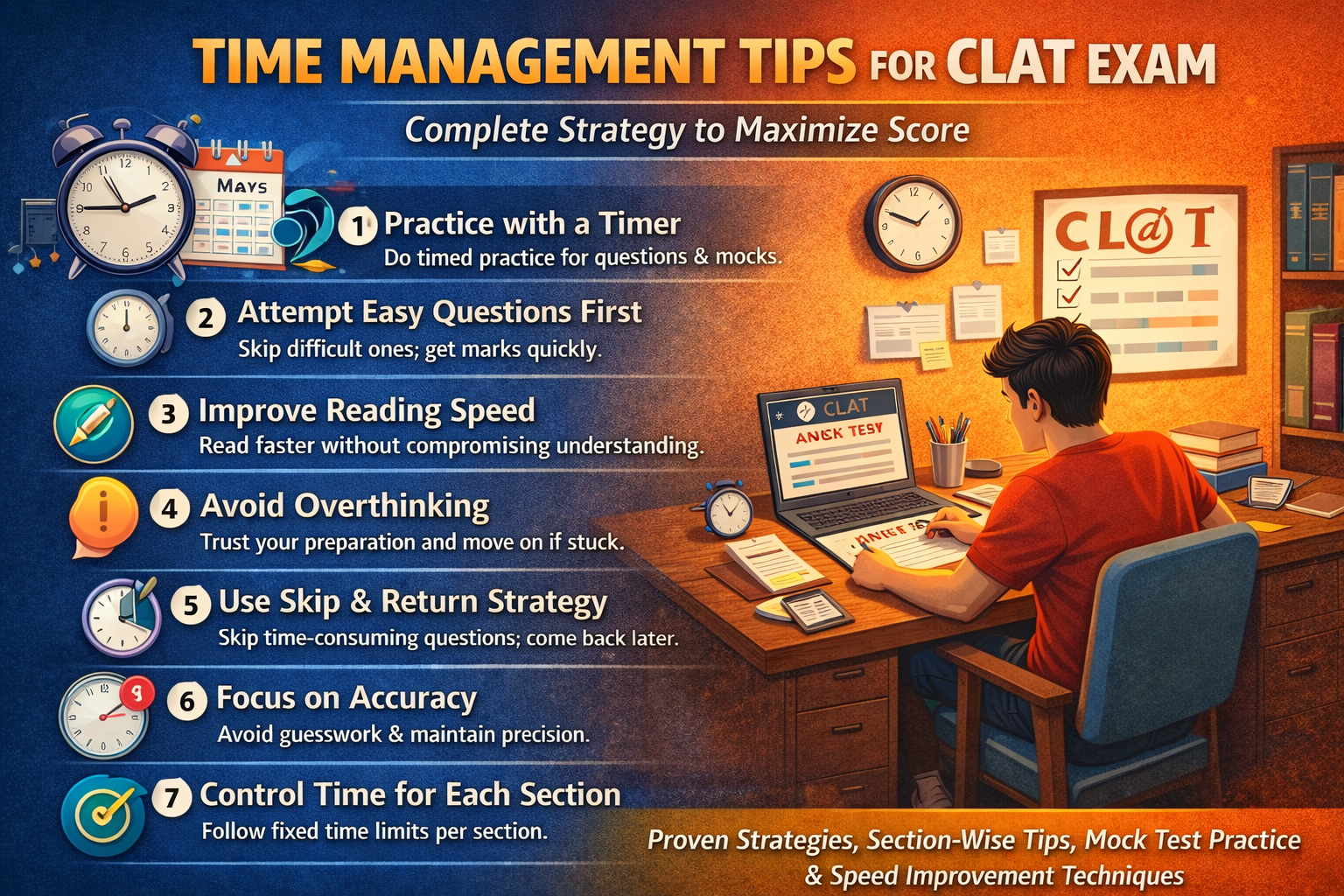
Key Time Management Tips for CLAT Exam
1. Practice with a Timer
Always practice questions and mock tests with a timer. This builds exam temperament and improves speed.
- Set time limits for each section
- Track how long you take per question
- Gradually reduce time per question
Keywords: timed practice CLAT, CLAT mock test timing, speed practice CLAT
2. Attempt Easy Questions First
Do not get stuck on difficult questions. Start with easy and moderate questions to secure marks quickly.
- Scan the passage before attempting
- Skip lengthy or confusing questions initially
- Return to difficult ones later
Keywords: smart attempt strategy CLAT, question selection CLAT, CLAT exam tips
3. Improve Reading Speed
Reading speed is crucial for CLAT because most questions are passage-based.
- Read newspapers daily
- Practice comprehension passages
- Avoid re-reading unnecessarily
Keywords: improve reading speed for CLAT, reading comprehension CLAT, CLAT English tips
4. Avoid Overthinking
Overthinking wastes valuable time and reduces efficiency.
- Trust your preparation
- Do not spend more than 1–2 minutes on one question
- Move on if unsure
Keywords: avoid overthinking CLAT, decision making CLAT, exam efficiency
5. Use the Skip and Return Strategy
If a question is taking too long, skip it and come back later.
- Mark questions for review
- Complete the entire paper first
- Use remaining time to solve difficult questions
Keywords: skip strategy CLAT, question prioritization CLAT, exam time saving tips
6. Focus on Accuracy Along with Speed
Speed without accuracy can lower your score due to negative marking.
- Avoid guesswork
- Attempt only when reasonably confident
- Maintain balance between speed and precision
Keywords: accuracy in CLAT, negative marking CLAT, smart guessing CLAT
7. Section-Wise Time Control
Stick to a fixed time for each section to avoid imbalance.
- Do not spend too much time on one section
- Move to the next section once time is up
- Practice section switching during mocks
Keywords: section control CLAT, balanced preparation CLAT, time discipline CLAT
8. Regular Mock Test Practice
Mock tests simulate the real exam environment and improve time management skills.
- Attempt full-length mocks weekly
- Analyze time spent per section
- Identify slow areas
Keywords: CLAT mock test strategy, CLAT practice tests, exam simulation CLAT
9. Analyze Your Time Usage
After every mock test, evaluate how you used your time.
- Which section took the most time
- Where you got stuck
- How much time was wasted
Keywords: CLAT time analysis, performance improvement CLAT, mock analysis CLAT
10. Develop a Fixed Exam Strategy
Having a predefined strategy reduces confusion during the exam.
- Decide section order in advance
- Set time limits for each section
- Follow the same strategy in mocks
Keywords: CLAT exam plan, pre exam strategy CLAT, CLAT attempt order
Section-Wise Time Management Strategy
English Language
- Quickly read passages
- Focus on main idea and tone
- Avoid spending too much time on vocabulary
Keywords: CLAT English timing, comprehension speed CLAT
Current Affairs and GK
- Attempt direct questions quickly
- Avoid spending time on unknown questions
- Keep this section short and precise
Keywords: GK time management CLAT, current affairs quick attempt
Legal Reasoning
- Allocate maximum time
- Read principles carefully
- Avoid re-reading passages multiple times
Keywords: legal reasoning timing CLAT, CLAT legal strategy
Logical Reasoning
- Focus on understanding arguments
- Avoid complex questions initially
- Practice critical reasoning regularly
Keywords: logical reasoning speed CLAT, reasoning time strategy
Quantitative Techniques
- Attempt easy questions first
- Use shortcuts and approximations
- Avoid lengthy calculations
Keywords: CLAT maths timing, quick calculation CLAT, DI speed
Daily Time Management Strategy for CLAT Preparation
- 2 hours for reading and comprehension
- 2 hours for concept building
- 2 hours for practice questions
- 1 hour for revision
- Weekly mock tests
Consistency in daily routine improves overall time efficiency.
Keywords: CLAT daily routine, study timetable CLAT, preparation schedule
Common Time Management Mistakes in CLAT
- Spending too much time on one section
- Ignoring mock test practice
- Not analyzing time usage
- Over-attempting questions
- Lack of a fixed strategy
Avoiding these mistakes can significantly improve performance.
Keywords: CLAT mistakes, time management errors CLAT, exam strategy mistakes
Last Minute Time Management Tips for CLAT
- Focus on mock tests and revision
- Avoid new topics
- Practice section-wise timing
- Stay calm and confident
Keywords: last minute CLAT tips, exam day strategy CLAT, final revision CLAT
FAQs: Time Management Tips for CLAT Exam
1. How important is time management in CLAT?
Time management is crucial as it directly affects your ability to attempt maximum questions with accuracy.
2. How can I improve my speed for CLAT?
Practice regularly with timers, attempt mock tests, and improve reading speed.
3. How much time should I give to each section in CLAT?
It depends on your strengths, but a balanced approach ensures full paper coverage.
4. Should I attempt all questions in CLAT?
No, focus on accuracy. Attempt only those questions you are reasonably confident about.
5. How many mock tests should I attempt?
At least 2–3 mock tests per week during serious preparation.
6. What is the best strategy during the CLAT exam?
Start with easy questions, manage time section-wise, and avoid spending too long on one question.
7. How to avoid panic during the exam?
Practice mock tests regularly and follow a fixed strategy.
8. Is skipping questions a good strategy?
Yes, skipping difficult questions initially saves time and improves overall attempts.
9. How to manage time in legal reasoning section?
Read passages carefully once and focus on applying logic rather than re-reading.
10. What should I do if I run out of time?
Prioritize easy questions and avoid guesswork to maintain accuracy.
