
Knowledge Nation Law Centre
Cracking the Common Law Admission Test (CLAT) in the first attempt is a dream for thousands of law aspirants across India. With increasing competition, changing exam patterns, and rising cut-offs, it has become essential to follow a smart and structured preparation strategy. Success in CLAT is not just about hard work; it is about consistent effort, proper planning, concept clarity, and regular practice.
This detailed guide will help you understand how to crack CLAT in the first attempt with proven strategies, section-wise preparation, study plans, and expert tips.
Understanding the CLAT Exam Pattern
Before starting your CLAT preparation, it is important to understand the exam pattern thoroughly. CLAT is designed to test comprehension, reasoning ability, and aptitude rather than rote learning.
CLAT Exam Sections
- English Language
- Current Affairs including General Knowledge
- Legal Reasoning
- Logical Reasoning
- Quantitative Techniques
The exam consists of passage-based questions that require strong reading skills, analytical thinking, and time management.
Keywords: CLAT exam pattern, CLAT syllabus, CLAT preparation strategy, CLAT sections
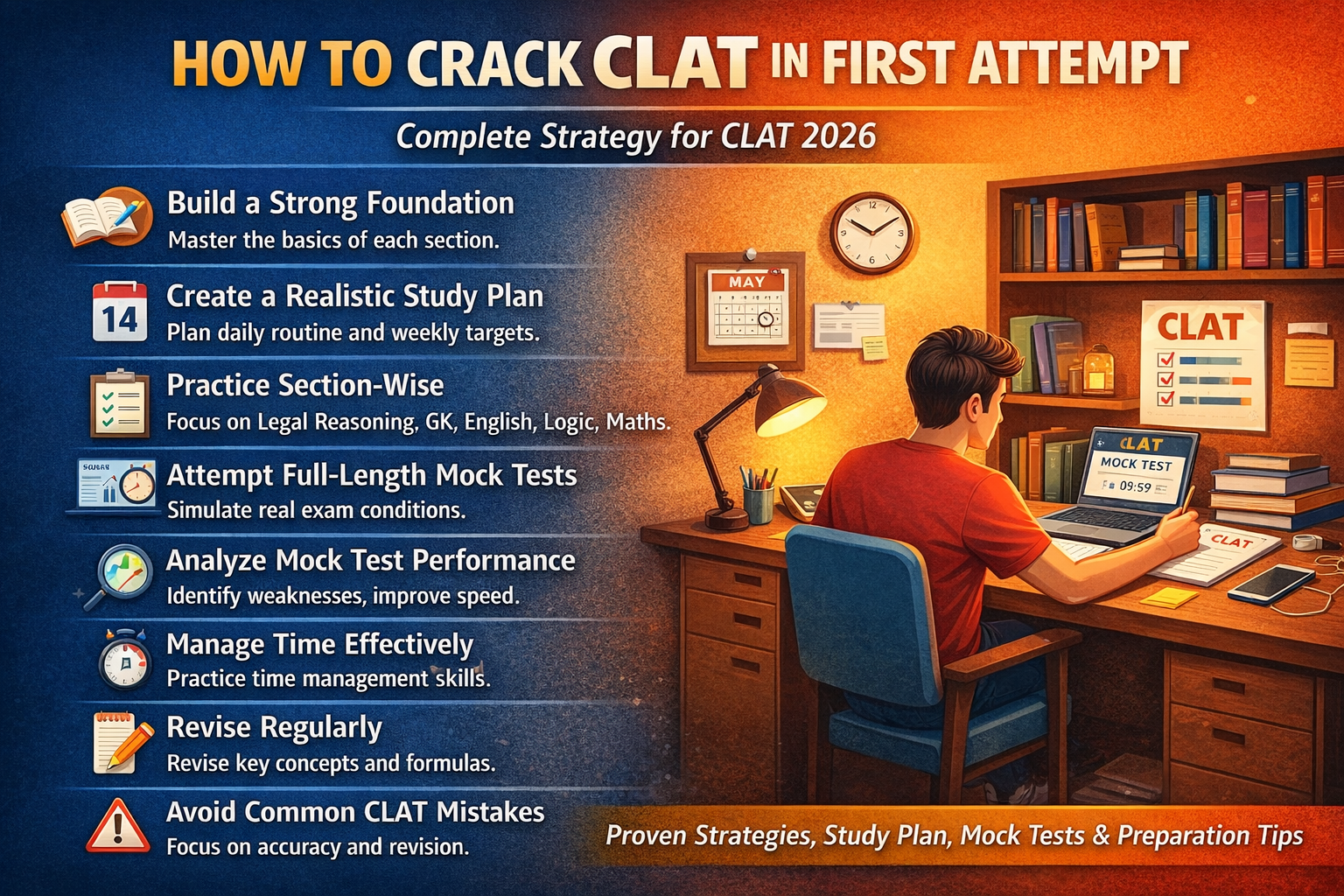
Step-by-Step Strategy to Crack CLAT in First Attempt
1. Build a Strong Foundation
The first step in CLAT preparation is building a strong conceptual base. Focus on understanding the fundamentals of each subject instead of memorizing facts.
- Improve reading habits
- Strengthen vocabulary
- Understand basic legal concepts
- Practice logical reasoning regularly
Keywords: CLAT basics, concept building for CLAT, CLAT preparation for beginners
2. Create a Realistic Study Plan
A well-structured study plan is essential for cracking CLAT in the first attempt. Divide your preparation into phases:
- Concept building phase
- Practice phase
- Revision phase
Allocate time to each section daily and ensure consistency.
Keywords: CLAT study plan, daily routine for CLAT, CLAT timetable
3. Focus on Reading Skills
Reading plays a crucial role in CLAT preparation. Almost all sections are passage-based, so improving reading speed and comprehension is critical.
- Read newspapers daily
- Practice comprehension passages
- Work on understanding tone and inference
Keywords: reading comprehension CLAT, improve reading speed for CLAT, CLAT English preparation
4. Section-Wise Preparation Strategy
English Language
- Focus on comprehension passages
- Improve vocabulary and grammar
- Practice error detection and sentence correction
Keywords: CLAT English preparation, vocabulary for CLAT, grammar practice CLAT
5. Practice Mock Tests Regularly
Mock tests are one of the most important aspects of CLAT preparation. They help you understand the exam pattern, improve speed, and identify weak areas.
- Attempt at least 2–3 mocks per week
- Analyze each mock test thoroughly
- Work on time management
Keywords: CLAT mock test, CLAT test series, CLAT practice papers
6. Analyze Your Performance
Attempting mock tests is not enough; analyzing them is equally important.
- Identify strengths and weaknesses
- Focus on improving weak areas
- Track your progress regularly
Keywords: CLAT performance analysis, improve CLAT score, mock test analysis
7. Time Management Strategy
Time management is crucial for cracking CLAT in the first attempt.
- Allocate time to each section
- Do not spend too much time on one question
- Practice solving papers within time limits
Keywords: time management for CLAT, CLAT exam strategy, speed and accuracy CLAT
8. Revision is the Key
Regular revision ensures that you retain what you have studied.
- Revise notes weekly
- Practice previous questions
- Focus on important topics
Keywords: CLAT revision strategy, last month CLAT preparation, CLAT notes
9. Stay Consistent and Motivated
Consistency is the most important factor in CLAT preparation.
- Study daily without long breaks
- Stay focused on your goal
- Avoid distractions
Keywords: CLAT motivation, consistency in CLAT preparation, study discipline
10. Avoid Common Mistakes
- Ignoring mock tests
- Not analyzing performance
- Lack of revision
- Over-reliance on one subject
- Poor time management
Keywords: CLAT mistakes, common errors in CLAT preparation, CLAT tips
Ideal Daily Routine for CLAT Aspirants
- 2–3 hours for reading and current affairs
- 2 hours for concept study
- 2 hours for practice questions
- 1 hour for revision
- Weekly mock tests
Keywords: CLAT daily schedule, study routine for CLAT, preparation timetable
Best Resources for CLAT Preparation
- Standard books for each section
- Online CLAT coaching platforms
- Previous year question papers
- Monthly current affairs magazines
Keywords: best books for CLAT, CLAT study material, CLAT preparation resources
Last 3 Months Strategy for CLAT
- Focus more on mock tests
- Revise all subjects thoroughly
- Improve speed and accuracy
- Avoid learning new topics
Keywords: last minute CLAT preparation, CLAT strategy last 3 months, CLAT revision plan
Importance of Self-Study in CLAT
Self-study plays a crucial role in cracking CLAT in the first attempt.
- Helps in better understanding
- Improves retention
- Builds confidence
Keywords: self study CLAT, how to prepare CLAT at home, CLAT preparation without coaching
FAQs: How to Crack CLAT in First Attempt
1. Can I crack CLAT in first attempt?
Yes, with proper strategy, consistency, and regular practice, cracking CLAT in the first attempt is achievable.
2. How many hours should I study daily for CLAT?
You should study 5–8 hours daily depending on your preparation level and consistency.
3. Is coaching necessary for CLAT preparation?
No, coaching is not mandatory. Many students crack CLAT through self-study and online resources.
4. What is the best time to start CLAT preparation?
Ideally, you should start preparation at least 1 year before the exam.
5. How important are mock tests in CLAT?
Mock tests are extremely important as they improve speed, accuracy, and exam confidence.
6. Which section is most important in CLAT?
All sections are important, but legal reasoning and current affairs carry significant weightage.
7. Can average students crack CLAT?
Yes, with consistent effort and proper guidance, average students can also crack CLAT.
8. How to improve reading speed for CLAT?
Read newspapers daily, practice comprehension passages, and focus on understanding context.
9. Is mathematics compulsory in CLAT?
Yes, quantitative techniques are part of CLAT, but the level is basic.
10. What should I do in the last month before CLAT?
Focus on revision, mock tests, and improving speed and accuracy. Avoid new topics.
