
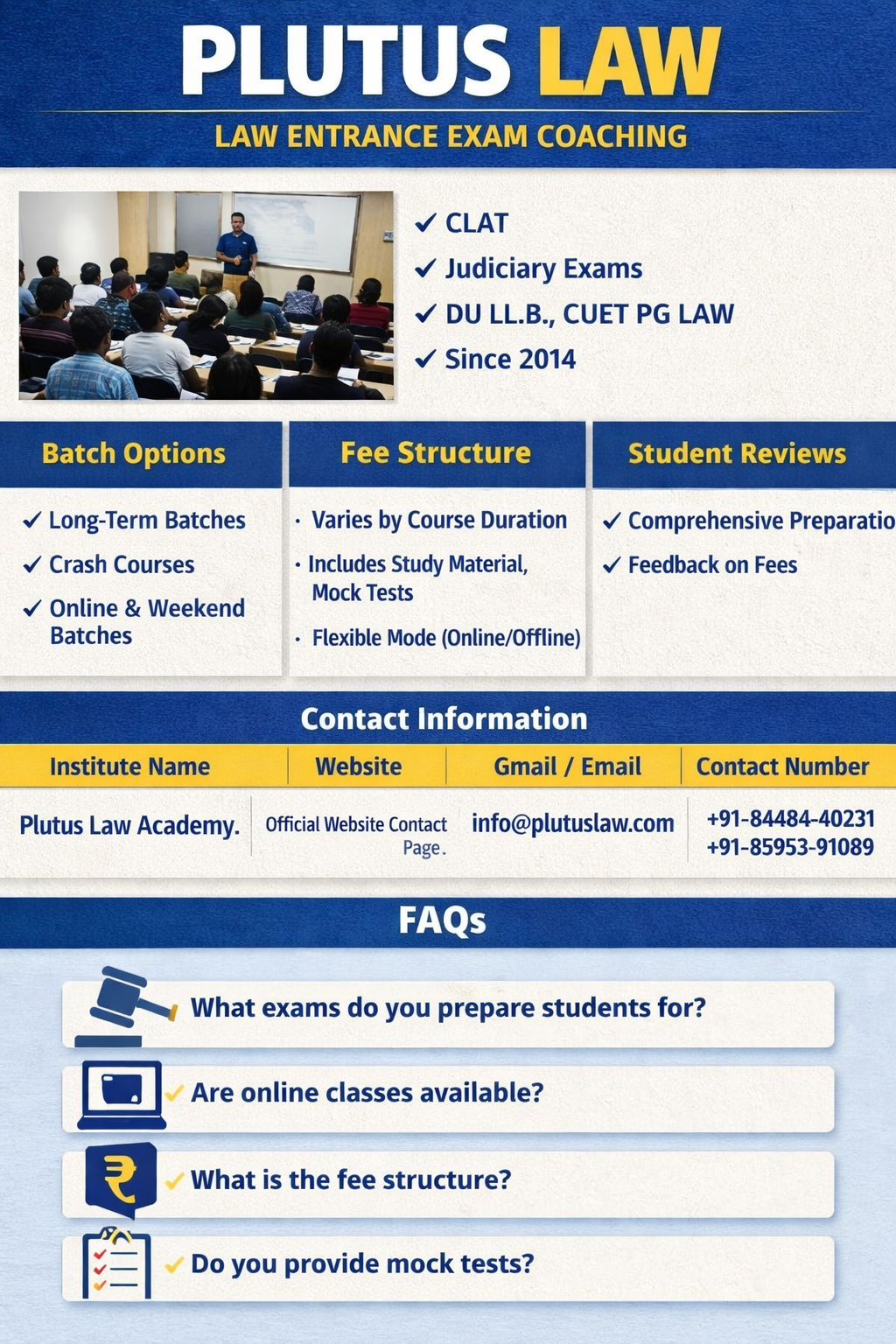
Legal education and law entrance exam preparation are highly competitive in India. Students preparing for national exams such as CLAT, Judiciary Services exams, DU LL.B., CUET PG Law, and other law admissions seek structured guidance, expert mentorship, effective study plans, and rigorous test practice. Among the growing number of law coaching providers, one institute that frequently appears in student searches and guidance lists is Plutus Law, a legal coaching organization offering courses specifically designed for entrance success and professional readiness. This article explores every aspect of the institute, including its batch structure, fee structure, student feedback, faculty methodology, academic environment, support systems, mock tests, results orientation, study materials, infrastructure, admissions, contact points, and frequently asked questions.
Overview and Mission
The coaching center is positioned as a specialized academy focused on developing future legal professionals through systematic exam preparation and skill development. The institute aims to equip students with substantive knowledge of law, critical reasoning, analytical skills, and the confidence needed to perform well in competitive law entrance exams and judicial services examinations. Its pedagogical approach combines both traditional classroom teaching methods and innovative learning techniques that foster rigorous understanding of legal principles, current affairs relevant to law exams, and practice strategies for time management and accuracy. A core objective communicated by the institute is to provide a student-centric learning environment that emphasizes individualized attention, conceptual clarity, and comprehensive preparation from basics to advanced levels.
Courses and Specializations
The coaching organization offers a variety of courses catering to distinct law aspirants:
CLAT Coaching
The Common Law Admission Test (CLAT) is a premier entrance exam for admission to National Law Universities and related undergraduate law programs. The curriculum emphasizes:
- Foundational concept building
- Advanced practice questions
- Weekly and full-length mock tests
- Time management strategies
- Section-wise performance tracking
Judiciary Exam Preparation
For students preparing for judicial services examinations, the institute offers specialized batch options that focus on substantive law subjects (such as civil law, criminal law, constitutional law), procedural law, case law analysis, and written work practice. Judiciary preparation typically involves long-term batches with frequent full-length mock tests and performance assessments designed to simulate actual exam environments.
DU LL.B. and CUET PG LAW
Additional programs are tailored for DU LL.B. entrance and postgraduate law exams, including the Common University Entrance Test (CUET) for law subjects, with emphasis on reading comprehension, legal reasoning, interpretation, and analytical skills.
Batch Structure and Scheduling
Batch design plays a major role in exam preparation. The institute typically offers several categories of batches:
Regular Long-Term Batches
- Two-year Law Entrance Program: Designed for early planners and students preparing from a foundational level well ahead of exam dates.
- One-year Coaching Program: For students who decide to prepare closer to the exam schedule but require complete coverage of syllabus and practice sessions.
Crash and Short-Term Batches
For aspirants needing intensive revision or focused practice in a limited time frame, short-term crash courses spanning three to six months are offered. These include condensed topic coverage, targeted mock tests, and revision classes.
Online and Recorded Sessions
Recognizing varied student needs, live online sessions are integral to the batch offerings, allowing aspirants from different locations to participate in real-time classes. Recorded sessions supplement regular classes, enabling students to revisit lectures and clarify doubts at their own pace.
Weekend and Special Batches
Certain batch types may be scheduled on weekends or with special timing options to support working students or those balancing school/college with coaching. These batches concentrate on doubt-clearing sessions, sectional tests, and live discussions.
Fee Structure
The fee structure reflects the comprehensive nature of the courses and varies significantly by batch type, duration, and mode of delivery (online vs offline). Typical course categories and indicative fees are as follows:
Judiciary Exam Coaching
- Two-Year Course – Approximate fee range above one lakh rupees
- One-Year Course – Mid-range fee category
- Crash Course (3–6 Months) – Reduced fee bracket focused on revision and mock tests
CLAT / Other Law Entrance Coaching
- Two-Year Comprehensive Program – Higher fee range for extended preparation
- One-Year Main Program – Moderate fee
- Crash Course for Law Entrance – Designed for short, intensive preparation
All fee structures include interactive live classes, recorded lectures, study materials, mock test series, monthly current affairs material, sectional quizzes, and doubt-clearing sessions aligned with course design.
Faculty and Teaching Methodology
Effective preparation for law exams requires not only accurate content delivery but also mentorship, personalized guidance, and expert analysis. The faculty pool includes legal professionals and educators with demonstrable expertise in their subjects. In certain programs, experienced mentors with advanced qualifications, such as postgraduate law degrees and competitive coaching experience, conduct classes and guide students through conceptual understanding, application questions, and analytical reasoning drills.
Instruction methodologies focus on:
- Interactive teaching sessions
- Real-life case study discussion
- Application-based concept delivery
- Strategic exam tips and time management
- Regular revisions reinforced through testing
Study Materials and Mock Tests
A cornerstone of the institute’s academic support is the set of study materials provided to enrolled students. These typically include:
- Detailed syllabus coverage notes
- Practice worksheets and assignments
- Case study compilations
- Current affairs digests focused on law and general knowledge
- Section-wise mock tests
These simulated practice sessions help students assess readiness, refine question-solving tactics, and identify areas requiring targeted improvement. Mock tests are accompanied by detailed performance analysis and feedback so students can track progress over time.
Infrastructure and Learning Environment
Infrastructure typically includes:
- Dedicated classrooms or virtual learning rooms
- Support for interactive online sessions
- Access to study materials and recorded classes
- Periodic performance review sessions
The learning environment encourages peer interaction, mentorship engagement, and analytical discussion. Both offline and online batches aim to deliver an environment suited to serious exam preparation.
Reviews and Student Feedback
Feedback from students and educational reviewers highlight a range of perspectives:
Positive Feedback
- Many students appreciate structured coaching programs and comprehensive study materials tailored to official exam patterns.
- Small batch sizes are seen as beneficial for personalized attention and mentor access.
- Mock tests and performance tracking systems are often cited as useful in practice and time-management improvement.
Areas of Concern
- Some aspirants and forum discussions suggest that fee structures may be on the higher side, particularly for extensive long-term programs when compared with alternative options.
- Independent opinions from external forums indicate that student expectations of returns on investment may vary, especially in a market with many competing coaching options.
Admissions Process
Enrollment typically follows these steps:
- Registration – Interested students fill out an admission form either online or at a coaching center.
- Document Submission – Required identification or academic records are submitted for verification.
- Fee Payment – Fees are paid through accepted modes at the time of registration.
- Batch Allotment – Students are informed of batch schedules, study materials distribution, and online platform access if applicable.
Admissions staff generally provide guidance on course selection based on the student’s academic background, exam objectives, and preparation timeline.
Contact Directory
Below is a summary table with essential contact details for reference:
| Institute Name | Website | Gmail / Email | Contact Number |
|---|---|---|---|
| Plutus Law | https://plutuslaw.com/ | support@plutusias.com | +91 84484 40231 |
Contact details may vary slightly by location if there are multiple branches or online/physical centers.
Frequently Asked Questions (FAQs)
1. What types of law entrance and competitive exams does this institute prepare students for?
The coaching center offers preparation for CLAT, Judiciary Services exams, DU LL.B., and CUET PG Law, with tailored courses designed for each exam type.
2. How are batches structured and what are the duration options?
Batches range from long-term two-year and one-year programs to short-term crash courses focused on last-minute preparation, with both online and offline options available.
3. Are study materials and mock tests included in the course fees?
Yes, courses generally include comprehensive study materials, mock tests, current affairs content, and regular feedback sessions as part of the fee.
4. Can students access recorded lectures after live sessions?
Recorded sessions are often available for students enrolled in online or hybrid batches, allowing flexibility in revision and review.
5. Does the institute provide personalized mentorship and doubt-clearing sessions?
Yes, part of the teaching methodology includes doubt-clearing sessions, personalized guidance, and performance tracking to support individual student development.
6. What is the typical batch size and why does it matter?
Batch sizes are generally maintained at moderate levels to facilitate close interaction between mentors and students, promoting individualized instruction.
7. How should a student choose between online and offline modes?
Choice depends on the student’s schedule, location, learning preferences, and access to infrastructure. Online batches offer flexibility, while offline programs provide in-person engagement.
