
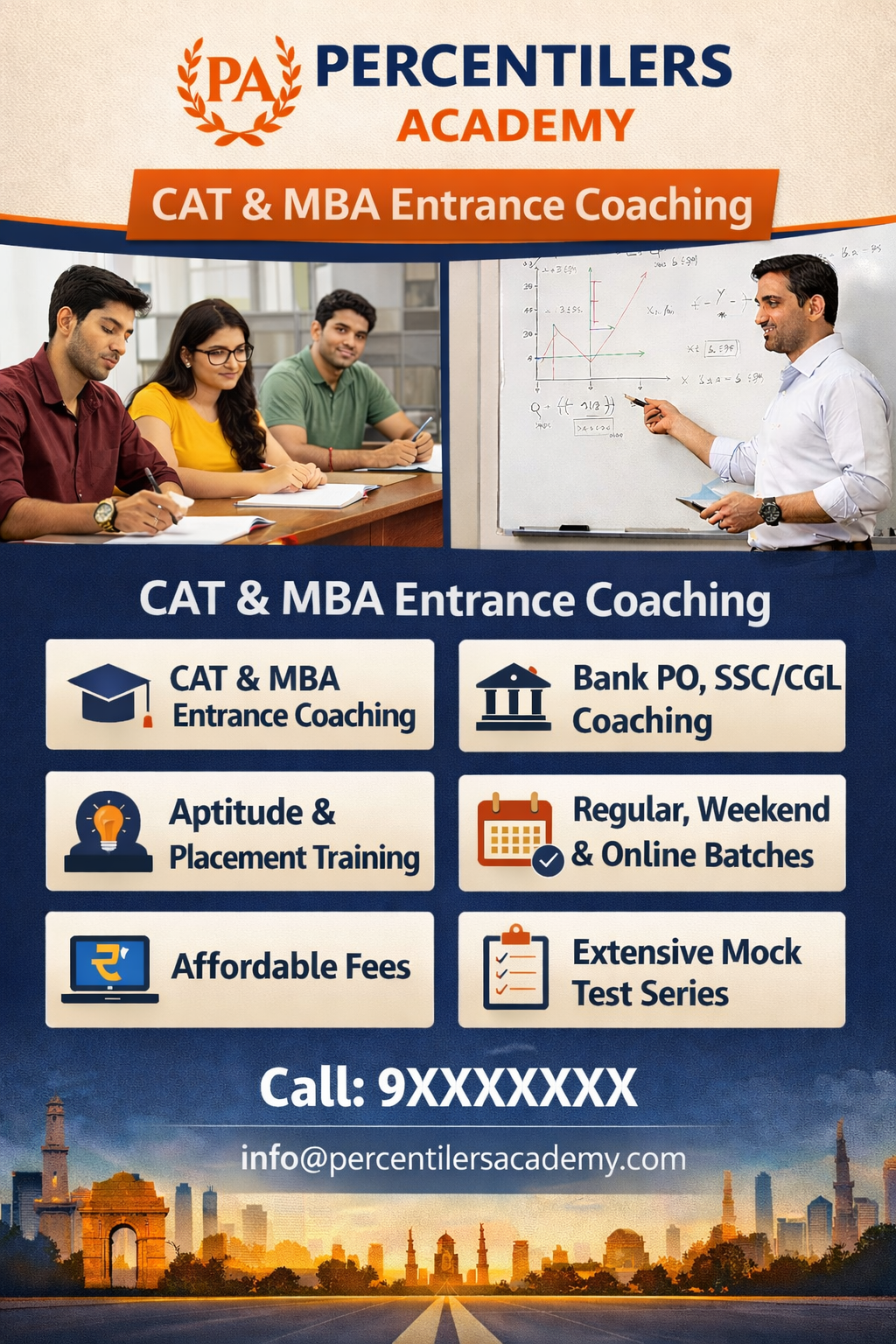
Percentilers Academy has established itself as a focused and performance-driven coaching institute catering to aspirants preparing for competitive aptitude-based examinations. The institute primarily serves students targeting MBA entrance exams, management aptitude tests, and corporate placement assessments. With a strong emphasis on percentile improvement, conceptual clarity, and strategic exam preparation, the academy appeals to both beginners and advanced learners.
The training philosophy is centered on structured learning, continuous evaluation, and personalized mentoring. Instead of adopting a one-size-fits-all approach, the institute works on identifying individual strengths and weaknesses, allowing students to gradually build confidence and competence. This adaptive model makes it suitable for students from varied academic backgrounds, including engineering, commerce, arts, and science.
Academic Vision or Training Philosophy
The academic framework followed at Percentilers Academy is designed to align with modern competitive exam patterns. The institute believes that success in aptitude examinations depends not only on knowledge but also on decision-making ability, time management, and psychological preparedness.
Classroom sessions are structured to ensure that foundational concepts are thoroughly understood before moving to advanced problem-solving techniques. Regular assessments help students track progress, while feedback-driven improvement plays a crucial role in strengthening weak areas. The learning environment encourages analytical thinking rather than rote memorization.
Courses Offered
The institute offers a comprehensive range of courses catering to different competitive exams and preparation stages.
MBA entrance exam preparation is one of the flagship offerings. These courses cover quantitative aptitude, data interpretation, logical reasoning, verbal ability, and reading comprehension in depth. Strategy sessions on question selection, accuracy improvement, and time optimization are integral parts of the curriculum.
These courses focus on numerical ability, reasoning skills, verbal communication, and interview preparation. Students benefit from company-specific practice modules and mock assessments.
These programs emphasize basic arithmetic, logical thinking, vocabulary development, and reading skills. The gradual learning curve helps students overcome fear of mathematics and aptitude-based subjects.
These short-term courses focus on intensive practice, mock test exposure, error analysis, and last-mile strategy refinement.
Batch Structure and Learning Modes
Weekday batches cater to full-time aspirants who can dedicate regular hours to preparation. Weekend batches are ideal for working professionals and college students managing academic or job commitments. Online and hybrid batches allow remote learners to access structured content without geographical limitations.
Each batch follows a predefined academic calendar that includes concept classes, practice sessions, revision lectures, and mock tests. This structured flow ensures complete syllabus coverage within the stipulated timeframe. Instead of adopting a one-size-fits-all approach, the institute works on identifying individual strengths and weaknesses, allowing students to gradually build confidence and competence. This adaptive model makes it suitable for students from varied academic backgrounds, including engineering, commerce, arts, and science.
Fee Structure and Affordability
The fee structure varies depending on the course type, duration, and learning mode. Comprehensive MBA entrance programs typically involve higher fees due to extended duration, detailed study material, and extensive mock test access. Foundation courses are comparatively affordable and suitable for early-stage aspirants.
Crash courses and test series are priced separately, allowing students to customize their preparation investment. Installment options may be available for select programs, making it financially manageable for students. Instead of adopting a one-size-fits-all approach, the institute works on identifying individual strengths and weaknesses, allowing students to gradually build confidence and competence. This adaptive model makes it suitable for students from varied academic backgrounds, including engineering, commerce, arts, and science.
Faculty and Teaching Expertise
Faculty members play a central role in shaping the learning experience. The teaching team consists of experienced aptitude trainers with specialization in quantitative aptitude, logical reasoning, data interpretation, and verbal ability.
Quantitative aptitude faculty focus on conceptual understanding, arithmetic clarity, and problem-solving techniques. Logical reasoning sessions emphasize structured thinking, pattern recognition, and logical sequencing. Verbal ability classes aim to improve grammar, vocabulary, comprehension speed, and contextual understanding.
Faculty members adopt an interactive teaching style, encouraging students to ask questions and participate actively in class discussions. Personalized feedback and mentoring help students stay aligned with their preparation goals.
Teaching Methodology
The teaching methodology follows a systematic and progressive approach. Each topic begins with conceptual explanation, followed by illustrative examples. Students then practice graded questions to strengthen understanding and build speed.Regular revision classes help reinforce learning and prevent concept decay. This layered approach ensures steady improvement over time. Instead of adopting a one-size-fits-all approach, the institute works on identifying individual strengths and weaknesses, allowing students to gradually build confidence and competence. This adaptive model makes it suitable for students from varied academic backgrounds, including engineering, commerce, arts, and science.
Study Material and Practice Resources
The study material is curated in-house and aligned with current exam patterns. Printed modules include theory notes, solved examples, and practice questions ranging from basic to advanced difficulty levels.
Digital resources supplement classroom learning and include recorded lectures, online practice sets, and mock tests. Topic-wise quizzes help students identify specific weaknesses, while full-length mocks simulate real exam conditions.
Mock analysis sessions are an essential part of the preparation process. Instead of adopting a one-size-fits-all approach, the institute works on identifying individual strengths and weaknesses, allowing students to gradually build confidence and competence. This adaptive model makes it suitable for students from varied academic backgrounds, including engineering, commerce, arts, and science.
Mock Tests and Performance Evaluation
Regular testing forms the backbone of the evaluation framework. Sectional tests, full-length mock exams, and time-bound practice sessions are conducted throughout the course duration. Instead of adopting a one-size-fits-all approach, the institute works on identifying individual strengths and weaknesses, allowing students to gradually build confidence and competence. This adaptive model makes it suitable for students from varied academic backgrounds, including engineering, commerce, arts, and science.
Performance analytics help students track progress across accuracy, speed, and consistency metrics. Faculty guidance during analysis sessions enables students to convert test results into actionable improvement plans.
Student Reviews and Feedback
Student reviews generally reflect satisfaction with teaching quality, structured curriculum, and mentoring support. Many students appreciate the clarity of explanations, especially in quantitative aptitude and reasoning sections.
Feedback often highlights the disciplined learning environment and regular testing schedule as major advantages. Students from non-technical backgrounds find the step-by-step teaching approach helpful in overcoming initial challenges. Instead of adopting a one-size-fits-all approach, the institute works on identifying individual strengths and weaknesses, allowing students to gradually build confidence and competence. This adaptive model makes it suitable for students from varied academic backgrounds, including engineering, commerce, arts, and science.
Some students emphasize that consistent self-study is necessary to fully benefit from the programs, indicating that results depend on individual effort along with institutional support.
Results and Track Record
The institute has demonstrated steady performance in terms of percentile improvement and exam success. Students have reported significant score gains after completing structured training programs. Instead of adopting a one-size-fits-all approach, the institute works on identifying individual strengths and weaknesses, allowing students to gradually build confidence and competence. This adaptive model makes it suitable for students from varied academic backgrounds, including engineering, commerce, arts, and science.
Success stories include strong performances in MBA entrance exams and improved outcomes in placement aptitude tests. Rather than focusing solely on toppers, the institute emphasizes overall batch performance and skill development.
Mentoring and Career Guidance
Students receive guidance on preparation planning, exam selection, and strategy development. Regular performance reviews help track improvement and recalibrate study plans.
Career counseling sessions assist students in aligning exam choices with long-term career goals. Pre-exam strategy workshops cover revision planning, stress management, and exam-day tactics.
Infrastructure and Academic Support
Online learners benefit from stable digital platforms that provide access to live classes, recordings, and assessments.
Administrative support ensures smooth batch operations, timely communication, and academic coordination. This structured support system enhances the overall learning experience.
Table: Institute Details
| Institute Name | Website | Gmail | Contact |
|---|---|---|---|
| PERCENTILERS ACADEMY | https://www.percentilers.in/ | pranshul@percentilers.in | +91 8218098825 |
Frequently Asked Questions
What exams are covered by the courses offered
The institute provides coaching for MBA entrance exams, aptitude-based competitive exams, and campus placement assessments.
Are beginner-level students eligible to enroll
Yes, foundation courses are designed specifically for beginners with minimal prior exposure to aptitude subjects.
Do working professionals have flexible batch options
Weekend and online batches are available to accommodate working professionals and busy students.
Is study material included in the course fee
Most programs include printed and digital study material along with mock test access.
Does the institute provide personalized mentoring
Yes, mentoring and performance review sessions are integral parts of the training process.
Are online classes as effective as classroom sessions
Online programs follow the same academic structure and offer live interaction, recordings, and practice resources.
Is interview preparation included
Selected courses include interview guidance and communication skill training, especially for placement-focused students.
