
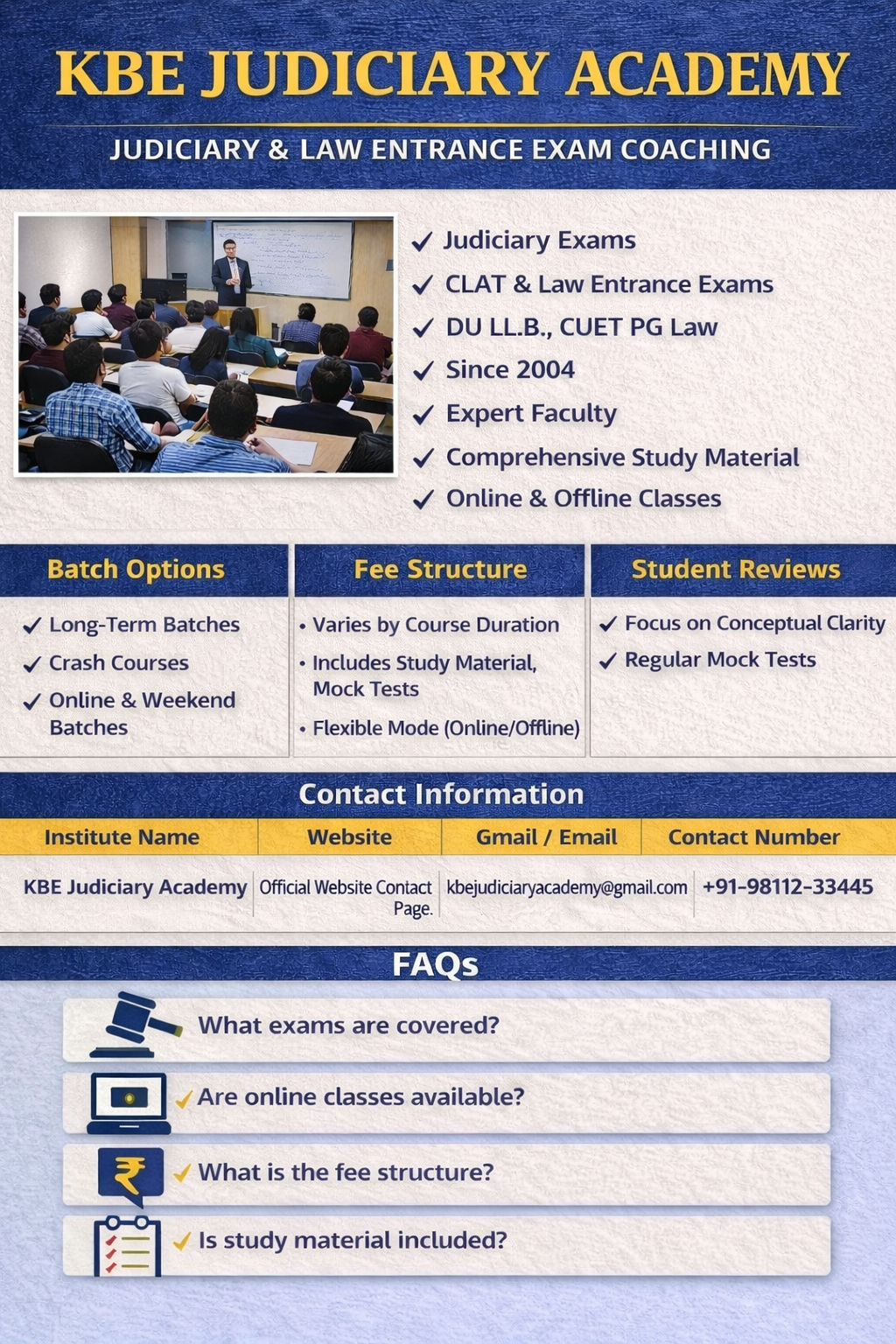
Legal education in India has evolved into one of the most competitive academic domains. With the growing demand for careers in judiciary services, law entrance exams, and postgraduate legal studies, aspirants increasingly rely on structured coaching programs. KBE Judiciary Academy has positioned itself as a dedicated institute specializing in judiciary and law exam preparation, providing aspirants with comprehensive academic support, expert faculty guidance, and structured study plans.
This article provides a detailed overview of the institute’s batch structures, fee frameworks, course offerings, teaching methodology, faculty approach, study materials, infrastructure, student feedback, admission process, and official contact information. The purpose is to help law aspirants make informed decisions regarding their coaching choices.
Overview of the Institute
The academy was established to provide focused coaching for aspirants preparing for judiciary exams at the state and national levels. It caters to candidates aiming for positions in the judiciary as well as those preparing for law entrance exams such as CLAT, DU LL.B., CUET PG Law, and other university-level examinations.
The institute emphasizes conceptual clarity, analytical reasoning, and application-based learning. Its teaching philosophy centers on consistent practice, performance evaluation, and development of strong problem-solving skills required in competitive examinations.
Courses and Programs Offered
The institute provides a variety of courses designed to meet different preparation requirements.
Judiciary Examination Coaching
Judiciary preparation is the primary offering of the academy. These courses focus on both preliminary and mains examinations and include the following subjects:
- Constitutional Law
- Indian Penal Code
- Civil Procedure Code
- Criminal Procedure Code
- Indian Evidence Act
- Contract Law
- Torts
- Family Law
- Property Law
- State-specific legislation
The courses emphasize answer writing, case law application, and exam-oriented practice.
CLAT and Law Entrance Examination Coaching
The academy offers structured coaching for law entrance exams such as CLAT and other undergraduate law programs. These courses aim to build reasoning, comprehension, and legal aptitude skills.
Key topics include:
- Legal reasoning and logical aptitude
- Analytical reasoning
- English comprehension and language skills
- General knowledge and current affairs
- Quantitative techniques
Teaching methods include passage-based questions, scenario-based problem-solving, and frequent mock tests.
DU LL.B. and CUET PG Law Coaching
For postgraduate and university-level law entrance exams, specialized programs are available. These courses focus on:
- Jurisprudence basics
- Legal awareness and interpretation
- Constitutional principles
- Analytical reasoning and problem-solving
- Mock tests and revision sessions
These programs are designed for candidates seeking in-depth understanding of law and exam readiness.
Academic Support and Law Optional Courses
The institute also supports students preparing for university semester exams and law optional papers. Short-term revision courses are available for:
- Targeted preparation for semester examinations
- Revision of important topics
- Practice-based learning for law optional subjects
Batch Structure and Scheduling
Batch planning is designed to accommodate students from various backgrounds and academic schedules.
Long-Term Batches
Long-term batches are ideal for aspirants beginning preparation early. These batches cover the syllabus comprehensively, allow gradual concept building, and provide multiple rounds of revision.
Short-Term and Crash Courses
Crash courses are designed for candidates who have previously studied the syllabus and require focused preparation. These batches emphasize high-weightage topics, practice tests, and exam strategy.
Weekend Batches
Weekend batches cater to working professionals and college students. They include extended sessions, intensive revisions, and doubt-clearing classes.
Online and Offline Modes
Both classroom-based and live online sessions are available. Online classes include interactive lectures, recorded sessions, and access to digital study materials. Batch sizes are maintained at a moderate level to ensure individual attention and effective interaction.
Fee Structure
The fee varies depending on course type, duration, and learning mode. Long-term judiciary programs typically require higher investment due to extensive syllabus coverage and mentoring support.
Indicative Fee Categories
- Judiciary preparation programs: Higher fee range
- Law entrance programs (CLAT, DU LL.B., CUET PG Law): Moderate fee range
- Crash and revision courses: Lower fee range
Fees generally include:
- Classroom or online lectures
- Study materials
- Mock tests
- Performance evaluations
- Doubt-solving sessions
Installment options may be available depending on the program.
Faculty and Teaching Methodology
The academy employs experienced faculty with both academic and practical expertise. The teaching methodology emphasizes conceptual clarity, analytical skills, and practical application of legal knowledge.
Key features include:
- Concept-focused lectures
- Case law discussions
- Practical examples and scenario-based learning
- Regular assessments and performance analysis
- Answer writing and exam strategy guidance
Faculty members mentor students on time management, structured answer writing, and efficient exam preparation.
Study Material and Test Series
Students receive carefully prepared study materials aligned with the latest exam trends. Materials are updated regularly to include changes in syllabus and legal developments.
Study materials include:
- Comprehensive notes by topic
- Case law summaries
- Practice question sets and assignments
- Current affairs updates
- Revision booklets
Mock tests are conducted at regular intervals to simulate actual exam conditions. Detailed feedback is provided to help students identify areas of improvement and track their performance.
Infrastructure and Learning Environment
The institute provides a disciplined and focused learning environment. Classrooms are designed to facilitate interactive learning, while online platforms support virtual instruction.
Students benefit from structured schedules, peer learning, and regular mentorship. The academy encourages consistent study habits, discipline, and accountability.
Reviews and Student Feedback
Student feedback provides insights into the effectiveness of the coaching programs.
Positive Highlights
- Conceptually strong teaching
- Judiciary-focused preparation
- Regular mock tests and assessments
- Supportive faculty guidance
- Comprehensive study material
Observations from Students
- Courses require consistent effort and discipline
- Judiciary programs demand long-term commitment
- Individual outcomes are influenced by dedication and practice
Overall, the feedback suggests the academy is suitable for serious aspirants preparing for judiciary and law examinations.
Admission Process
The admission process is simple and transparent.
Steps include:
- Initial inquiry and counseling
- Course selection based on exam goals
- Submission of required documents
- Fee payment and batch allocation
Counseling sessions help students choose suitable batches according to preparation timelines and objectives.
Contact Details
| Institute Name | Website | Gmail / Email | Contact Number |
|---|---|---|---|
| KBE Judiciary Academy | https://www.kbejudiciarycoaching.com/ | kbejudiciarycoaching@gmail.com | +91-7503333777 |
Frequently Asked Questions (FAQs)
1. Which exams are covered by the coaching programs?
The academy provides preparation for judiciary exams, CLAT, DU LL.B., CUET PG Law, and university-level law tests.
2. Are online classes available?
Yes, live online classes with recorded lectures are available for selected courses.
3. What is the batch size?
Batches are moderate in size to ensure personalized attention and interactive learning.
4. Is study material included in the fee?
Yes, most courses include study materials, mock tests, and revision resources.
5. Does the judiciary program include answer writing practice?
Yes, answer writing and case law application are integral parts of the curriculum.
6. Are crash courses suitable for beginners?
Crash courses are more suitable for students who already have basic preparation.
7. How can students enroll?
Enrollment is done through counseling, document submission, fee payment, and batch allocation.
