
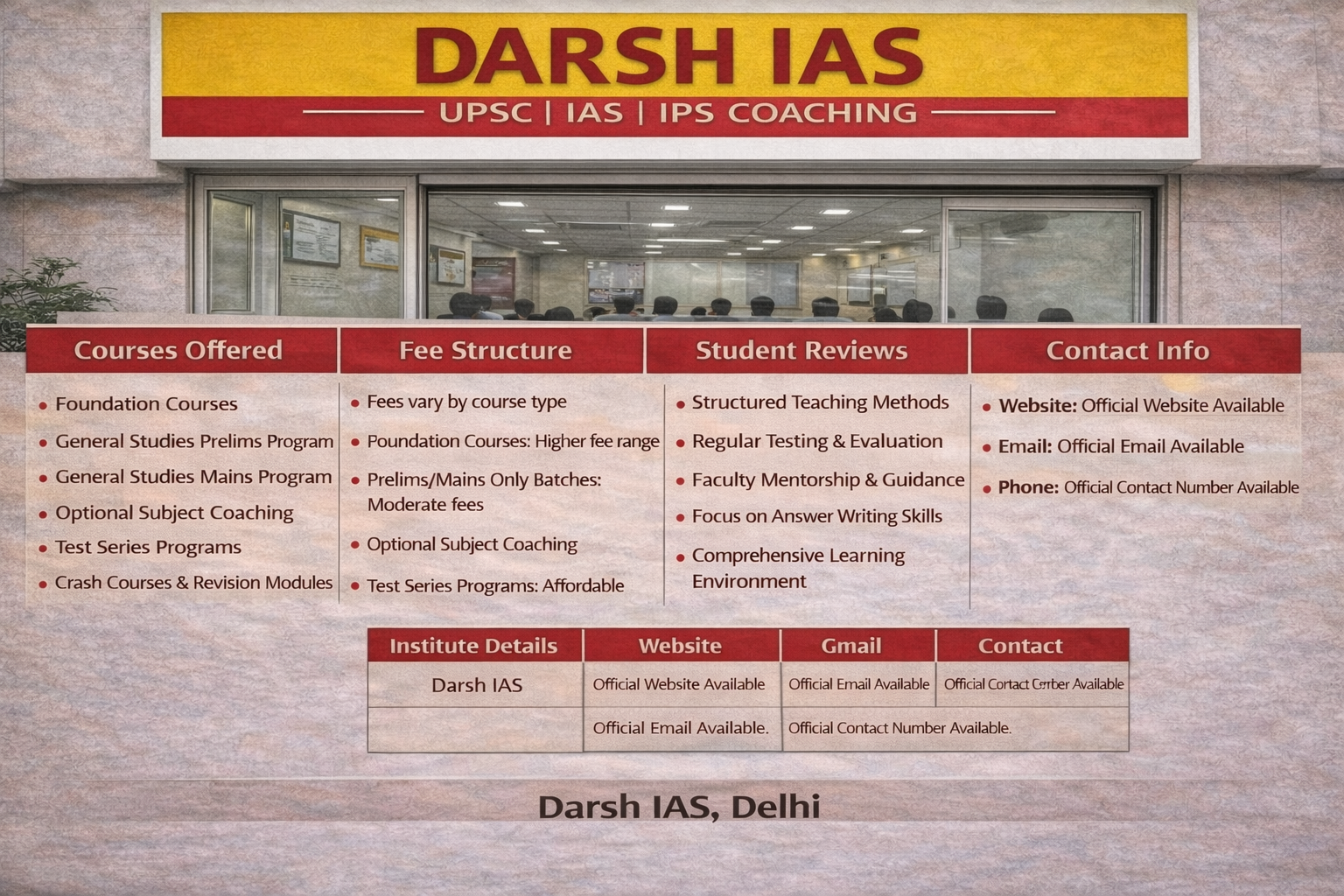
Civil Services Examination preparation demands sustained effort, structured guidance, and continuous evaluation. Aspirants often look for coaching institutes that provide not only syllabus coverage but also mentorship, exam-oriented strategies, and a disciplined academic environment. Darsh IAS has emerged as a coaching institute catering to aspirants who seek systematic preparation supported by conceptual clarity, regular practice, and performance assessment.
The institute focuses on providing comprehensive guidance for different stages of the UPSC Civil Services Examination. With a structured academic framework, subject-wise teaching methodology, and student-centric mentoring, the institute aims to help aspirants develop the skills required to handle the dynamic and competitive nature of the examination.
This detailed article explores the academic approach, batch structure, fee framework, faculty support, study material, student feedback, and contact-related details to provide aspirants with a clear understanding of the institute’s offerings.
Academic Vision and Preparation Philosophy
The academic philosophy followed emphasizes clarity of concepts, relevance to the syllabus, and consistent evaluation. The focus is not limited to completing the syllabus but extends to ensuring that aspirants understand how to apply knowledge effectively in both objective and descriptive examinations.
The teaching model promotes:
- Strong foundation in static subjects
- Integration of current affairs with conceptual topics
- Analytical thinking and issue-based understanding
- Structured answer writing and presentation
- Regular testing and feedback
Aspirants are encouraged to develop discipline, consistency, and independent analytical abilities alongside classroom learning.
Courses and Programs Offered
The institute offers a range of courses designed to meet the needs of aspirants at different stages of preparation. These programs are structured to support beginners, intermediate learners, and experienced candidates.
Foundation Course for Civil Services
The foundation course is intended for aspirants who are beginning their UPSC journey. This program covers the entire General Studies syllabus for both Preliminary and Main examinations.
Key features include:
- Detailed coverage of History, Geography, Polity, Economy, Environment, Science and Technology, and Ethics
- Basic orientation to answer writing
- Regular current affairs sessions
- Periodic tests and revision modules
- Conceptual clarity with gradual syllabus progression
The foundation course aims to build a strong academic base and disciplined study routine.
General Studies Prelims Program
The Prelims program focuses on objective-type preparation and accuracy. It is suitable for both first-time aspirants and repeat candidates.
Program highlights include:
- Topic-wise coverage aligned with the Preliminary syllabus
- Extensive MCQ practice
- CSAT preparation support
- Previous year question analysis
- Full-length mock tests and performance analysis
The emphasis is on developing speed, accuracy, and elimination techniques.
General Studies Mains Program
The Mains-oriented program emphasizes descriptive answer writing, analytical depth, and structured presentation.
Key aspects include:
- In-depth coverage of GS Papers I, II, III, and IV
- Ethics and case study discussions
- Essay writing guidance
- Regular answer-writing practice with evaluation
- Content enrichment through current affairs integration
This program helps aspirants develop the clarity and structure required for scoring well in the Main examination.
Optional Subject Coaching
Optional subject coaching is offered for selected subjects based on faculty expertise and student demand.
These are features:
- Complete syllabus coverage
- Conceptual explanation and analytical approach
- Discussion of previous year questions
- Regular tests and feedback
The preparation is handled with focused attention due to its importance in the final merit ranking.
Test Series Programs
Test series programs are a core component of the preparation framework. Both Prelims and Mains test series are available.
Key features include:
- Topic-wise tests for systematic evaluation
- Full-length mock examinations
- Detailed answer evaluation
- Ranking and comparative analysis
- Strategy improvement sessions
Test series programs help aspirants assess their preparation level and refine their approach.
Crash Courses and Revision Modules
Crash courses are designed for aspirants who have completed the syllabus and need intensive revision before the examination.
Highlights include:
- Condensed coverage of high-priority topics
- Current affairs consolidation
- Practice tests and discussions
- Last-phase exam strategy guidance
These programs are time-bound and focused on revision and confidence-building.
Batch Structure and Timings
The institute maintains a structured batch system to ensure effective learning and individual attention.
Batch features include:
- Morning batches for full-time aspirants
- Evening batches for working professionals
- Weekend batches for students with time constraints
- Limited batch size to maintain interaction quality
The batch structure supports flexibility while maintaining academic discipline.
Teaching Methodology
The teaching methodology focuses on simplifying complex concepts and making learning exam-oriented. Faculty members emphasize clarity, relevance, and application-based understanding.
Teaching practices include:
- Concept-based classroom lectures
- Interactive discussions and doubt-clearing sessions
- Use of diagrams, flowcharts, and real-world examples
- Integration of static subjects with current affairs
- Continuous practice through tests and assignments
Answer-writing skills are developed gradually through guided practice and structured feedback.
Faculty and Mentorship Support
Faculty members play a central role in shaping aspirant preparation. The institute focuses on subject specialists who guide students through both conceptual understanding and exam strategy.
Mentorship support includes:
- Personalized study planning
- Regular performance reviews
- Strategy sessions for Prelims and Mains
- Motivation and consistency guidance
Mentorship helps aspirants stay focused and aligned with their preparation goals.
Study Material and Academic Resources
The institute provides structured study material aligned with the UPSC syllabus. The material is curated to reduce dependency on multiple external sources.
Study resources include:
- Printed classroom notes
- Topic-wise handouts
- Current affairs compilations
- Practice questions and model answers
- Test series booklets
The material is periodically updated to reflect changing exam trends.
Infrastructure and Learning Environment
A conducive learning environment supports long-term preparation. The institute aims to provide facilities that encourage focus and academic engagement.
Infrastructure features include:
- Well-equipped classrooms
- Comfortable seating arrangements
- Study-friendly academic atmosphere
- Support for online learning where applicable
The environment encourages peer learning and constructive academic interaction.
Fee Structure Overview
The fee structure varies depending on the course type, duration, and level of coverage.
General trends include:
- Foundation courses have higher fees due to comprehensive syllabus coverage
- Prelims-only and Mains-only programs are moderately priced
- Optional subject coaching fees vary by subject
- Test series programs are comparatively affordable
Installment options or fee concessions may be available based on institute policies.
Reviews and Student Feedback
Student feedback provides insights into the academic experience at the institute.
Commonly Highlighted Strengths
- Structured and syllabus-oriented teaching
- Regular testing and evaluation
- Faculty support and mentorship
- Emphasis on answer-writing skills
Areas Mentioned by Students
- Need for consistent self-study alongside coaching
- Variation in teaching pace across subjects
- Importance of disciplined attendance
Overall feedback suggests that aspirants who actively engage with the programs and maintain consistency benefit the most.
Peer Learning and Academic Exposure
Peer interaction is encouraged through classroom discussions, test analysis sessions, and group activities.
Benefits include:
- Exposure to diverse viewpoints
- Enhanced analytical thinking
- Motivation through healthy competition
- Improved answer presentation skills
Peer learning adds value to the overall preparation process.
Institute Details Table
| Institute Name | Website | Gmail | Contact |
|---|---|---|---|
| Darsh IAS | https://darshias.com/ | theiasacademydelhi@gmail.com | +91-92058 18633 |
Frequently Asked Questions (FAQs)
Q1. What courses are offered at this institute?
The institute offers foundation courses, Prelims programs, Mains-oriented courses, optional subject coaching, test series, and crash courses.
Q2. Is the institute suitable for beginners?
Yes, foundation courses are designed for aspirants starting their preparation from scratch.
Q3. Are current affairs covered regularly?
Current affairs are integrated with static subjects through classroom sessions and study material.
Q4. Does the institute provide answer-writing practice?
Answer-writing practice is a key component, especially in Mains-oriented programs.
Q5. Are online classes available?
Online learning options may be available depending on batch structure and academic planning.
Q7. Is mentorship provided?
Yes, mentorship support is provided to guide aspirants in study planning and exam strategy.
Q8. Are optional subjects available?
Optional subjects are offered based on faculty availability and student demand.
Q9. Does coaching guarantee selection?
No coaching institute can guarantee selection; success depends on individual effort, consistency, and effective use of guidance.
