
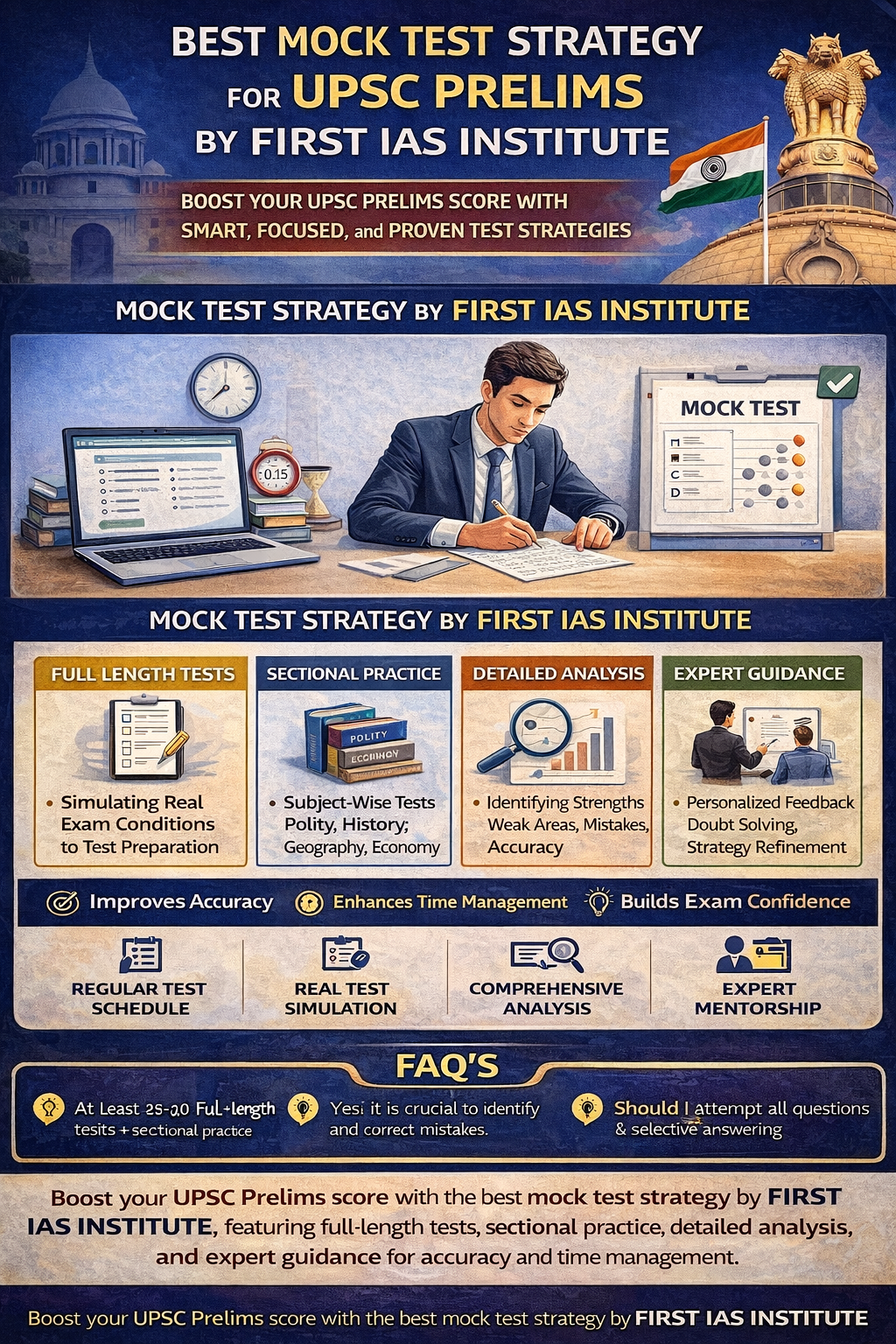
The UPSC Civil Services Preliminary Examination is the first and most crucial stage of the selection process. It serves as a screening test, but its importance cannot be underestimated because it determines whether an aspirant will move forward to the Mains stage. With increasing competition and evolving question patterns, relying only on theoretical study is not sufficient. A strong mock test strategy is essential for success in UPSC Prelims.
FIRST IAS Institute provides a well-structured and result-oriented mock test strategy designed to help aspirants improve accuracy, enhance time management, and build exam temperament. Through a combination of regular testing, detailed analysis, and expert guidance, aspirants can significantly improve their performance.
Importance of Mock Tests in UPSC Prelims Preparation
Mock tests are an integral part of UPSC preparation. They simulate the real exam environment and help aspirants understand the nature of questions asked in the exam.
Key benefits of mock tests include:
- Familiarity with exam pattern
- Improvement in speed and accuracy
- Identification of strengths and weaknesses
- Better time management
- Reduction of exam anxiety
FIRST IAS Institute ensures that aspirants get sufficient practice through a comprehensive test series aligned with the latest UPSC pattern.
Understanding the UPSC Prelims Exam Pattern
Before starting mock test practice, it is essential to understand the structure of the Prelims exam.
The Prelims consists of two papers:
- General Studies Paper I
- CSAT (Civil Services Aptitude Test)
While GS Paper I determines merit, CSAT is qualifying in nature but still requires adequate preparation.
FIRST IAS Institute designs mock tests that closely resemble the actual UPSC exam pattern, ensuring realistic practice.
When to Start Mock Test Practice
One of the most common questions among aspirants is when to start taking mock tests.
FIRST IAS Institute recommends:
- Starting mock tests after completing basic syllabus
- Beginning with sectional tests
- Gradually moving to full-length tests
- Increasing frequency closer to the exam
Early exposure to mock tests helps in building confidence and improving performance.
Sectional Tests for Concept Clarity
Sectional tests focus on specific subjects such as Polity, History, Geography, and Economy.
Benefits include:
- Strengthening subject-wise concepts
- Identifying weak areas
- Improving topic-wise accuracy
- Building confidence gradually
FIRST IAS Institute provides subject-wise tests to ensure thorough preparation.
Full-Length Mock Tests for Exam Simulation
Full-length tests simulate the actual UPSC Prelims exam. They help aspirants practice under real exam conditions.
Key advantages:
- Time-bound practice
- Real exam experience
- Improved time management
- Better question selection strategy
FIRST IAS Institute conducts regular full-length tests to prepare students for the final exam.
Importance of Test Analysis
Taking mock tests is not enough; analyzing them is equally important.
FIRST IAS Institute emphasizes detailed test analysis, which includes:
- Reviewing correct and incorrect answers
- Understanding the logic behind questions
- Identifying recurring mistakes
- Improving accuracy
Proper analysis helps aspirants avoid repeating the same mistakes.
Accuracy vs Attempt Strategy
One of the most critical aspects of Prelims preparation is balancing accuracy and attempts.
FIRST IAS Institute guides aspirants to:
- Avoid blind guessing
- Focus on eliminating wrong options
- Maintain a balance between risk and safety
- Aim for high accuracy rather than maximum attempts
A well-planned attempt strategy increases the chances of clearing the cutoff.
Time Management During Mock Tests
Time management is crucial in the Prelims exam. Aspirants often struggle to complete the paper within the given time.
FIRST IAS Institute trains students to:
- Allocate time for each section
- Avoid spending too much time on difficult questions
- Practice quick decision-making
- Maintain a steady pace throughout the exam
Regular practice helps in mastering time management.
Revision Through Mock Tests
Mock tests are not only for practice but also for revision.
FIRST IAS Institute encourages:
- Revising topics based on test performance
- Focusing on frequently asked questions
- Strengthening weak areas
- Maintaining short notes for quick revision
This approach ensures better retention of information.
Use of Previous Year Questions
Previous year questions (PYQs) play a crucial role in understanding UPSC trends.
FIRST IAS Institute integrates PYQs into mock tests to help aspirants:
- Understand question patterns
- Identify important topics
- Improve problem-solving skills
- Build confidence
Practicing PYQs along with mock tests enhances preparation.
CSAT Mock Test Strategy
Many aspirants underestimate CSAT, which can be risky.
FIRST IAS Institute provides:
- Regular CSAT practice tests
- Focus on comprehension and reasoning
- Time management techniques
- Strategies for qualifying marks
Balanced preparation for both papers is essential.
FAQ’s
1. How many mock tests should I attempt for UPSC Prelims?
Aspirants should attempt at least 25–30 full-length tests along with sectional tests for effective preparation.
2. When should I start taking mock tests?
Mock tests should be started after completing the basic syllabus, beginning with sectional tests and moving to full-length tests.
3. Is test analysis important?
Yes, analysis is crucial to identify mistakes, improve accuracy, and refine strategy.
4. How to improve accuracy in mock tests?
Focus on concept clarity, avoid guesswork, and practice elimination techniques.
5. Should I attempt all questions in Prelims?
No, it is better to attempt questions with higher confidence and maintain accuracy.
6. How does FIRST IAS Institute help in mock test preparation?
It provides structured test series, detailed analysis, expert guidance, and personalized feedback.
7. Is CSAT important for Prelims?
Yes, CSAT is qualifying but requires proper preparation to avoid failure.
8. How to manage time during the exam?
Practice regularly, allocate time wisely, and avoid spending too much time on difficult questions.
