
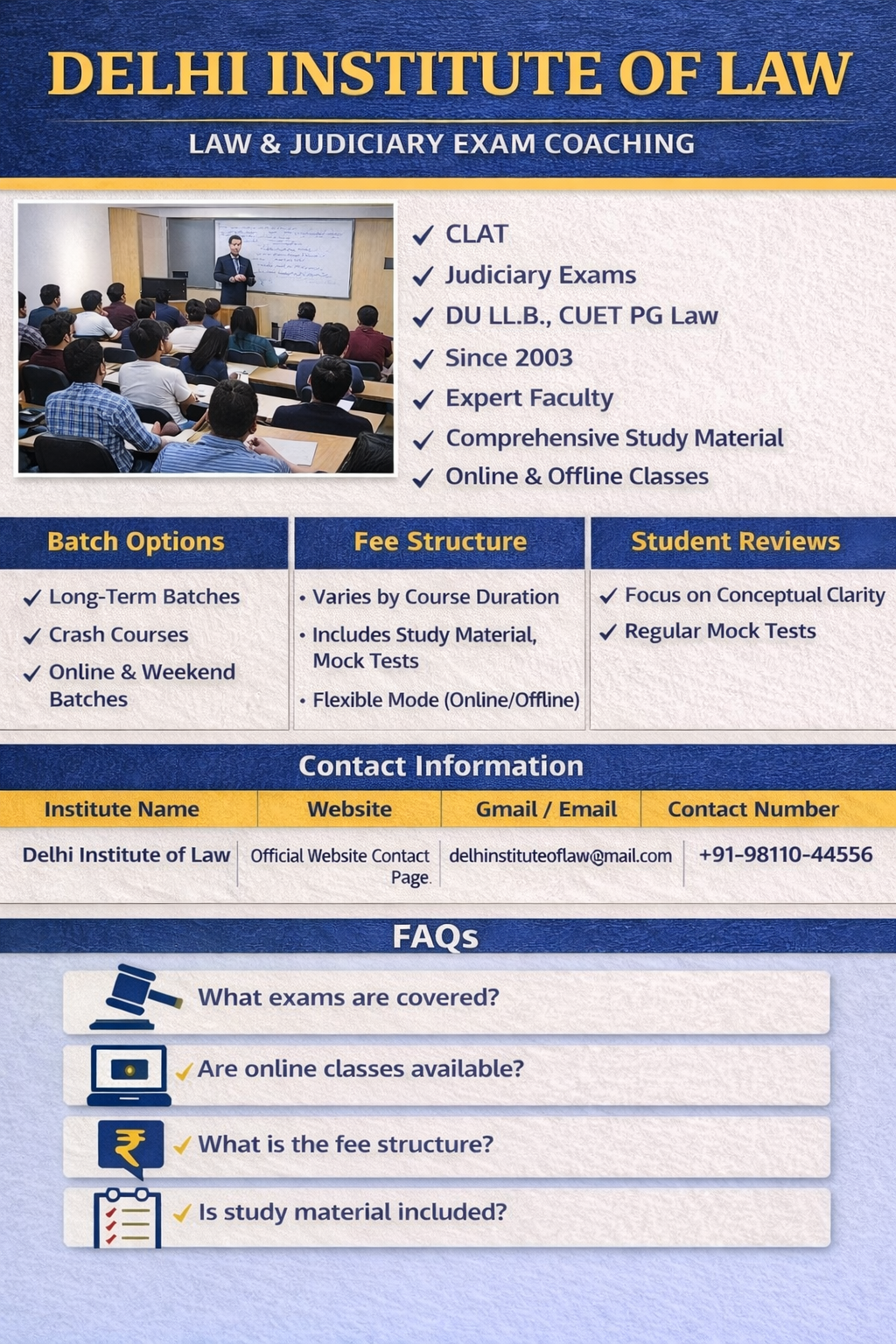
The demand for professional legal education has grown rapidly in India due to increasing competition in judiciary examinations, law entrance tests, and postgraduate legal programs. Aspirants preparing for CLAT, DU LL.B., CUET PG Law, judiciary services, and other law-related examinations often look for structured coaching that offers conceptual clarity, exam-oriented guidance, and consistent academic support. Delhi Institute of Law is among the coaching platforms that focus on systematic legal education and competitive exam preparation.
This detailed guide explores all essential aspects related to courses, batch structure, fees, faculty approach, study material, student reviews, infrastructure, admission procedure, and official contact information. The objective is to provide aspirants with comprehensive insights to help them evaluate whether the institute aligns with their academic goals.
Overview of the Institute
The institute was established with the aim of providing specialized coaching for law entrance and judiciary examinations. It caters to students from diverse academic backgrounds, including fresh graduates, repeat candidates, and working professionals. The academic framework emphasizes understanding of legal principles, analytical reasoning, and application-based learning.
The teaching philosophy focuses on building strong fundamentals in law subjects while gradually preparing students for complex legal problem-solving required in competitive examinations. Structured schedules, continuous evaluation, and regular mentoring form the backbone of the academic model.
Courses and Programs Offered
The institute offers a variety of law-focused coaching programs designed to meet the needs of different examinations and preparation timelines.
CLAT and Law Entrance Examination Coaching
Coaching for CLAT and other undergraduate law entrance exams is structured around the latest syllabus and exam pattern. The program focuses on developing comprehension skills and legal reasoning abilities.
Core areas covered include:
- Legal reasoning and aptitude
- Logical reasoning
- English language and comprehension
- General knowledge and current affairs
- Quantitative techniques
The curriculum combines concept classes with extensive practice through passage-based questions and mock tests.
Judiciary Examination Preparation
Judiciary coaching is one of the major academic offerings. These programs are designed for aspirants preparing for state judicial services examinations, including preliminary and mains stages.
Subjects typically covered include:
- Constitutional Law
- Indian Penal Code
- Code of Criminal Procedure
- Code of Civil Procedure
- Indian Evidence Act
- Contract Law
- Torts
- Family Law
- Property Law
- Local and state-specific laws
Special emphasis is placed on answer writing practice, legal drafting, and case law application.
DU LL.B. and CUET PG Law Coaching
For postgraduate law entrance exams, dedicated coaching modules are available. These programs focus on legal awareness, interpretation skills, and analytical reasoning.
Preparation includes:
- Constitutional principles
- Jurisprudence fundamentals
- Legal current affairs
- Statutory interpretation
- Practice tests and revision sessions
Academic Support and Law Optional Programs
In addition to entrance exam coaching, the institute also supports law students preparing for university semester examinations and law optional papers. Short-term revision courses and subject-specific modules are available for targeted preparation.
Batch Structure and Scheduling
Batch planning is designed to accommodate students with varying academic commitments and preparation timelines.
Long-Term Batches
Long-term batches are suitable for students starting preparation early. These batches focus on detailed syllabus coverage, gradual concept building, and multiple revision cycles.
Short-Term and Crash Courses
Crash courses are designed for aspirants who have already completed the syllabus and require intensive revision. These batches emphasize high-weightage topics, exam strategies, and frequent mock tests.
Weekend Batches
Weekend batches cater to working professionals and college students. Classes are conducted on weekends with extended sessions, doubt-clearing discussions, and revision classes.
Online and Offline Learning Modes
Both classroom-based and online live classes are offered. Online batches include interactive lectures, recorded sessions, and digital study materials for flexible learning.
Batch sizes are generally kept moderate to ensure personal attention and effective interaction between faculty and students.
Fee Structure
The fee structure varies depending on the course type, duration, and learning mode. Judiciary preparation programs usually involve higher fees due to extensive syllabus coverage and long-term mentoring.
General Fee Categories
- Judiciary examination courses: Higher fee range
- Law entrance preparation programs: Moderate fee range
- Crash and revision courses: Lower fee range
Fees usually include:
- Classroom or online lectures
- Study materials
- Mock test series
- Performance evaluation
- Doubt-solving sessions
Installment facilities may be available for select programs.
Faculty and Teaching Methodology
The faculty team consists of experienced law educators with academic and practical expertise. Teaching focuses on concept clarity, application-based learning, and exam-oriented preparation.
Key features of the teaching methodology include:
- Concept-based lectures
- Case law discussions
- Practical illustrations
- Regular assessments
- Answer writing guidance
Faculty members provide mentoring on time management, exam strategy, and structured answer presentation.
Study Material and Mock Test Series
Students receive well-structured study material aligned with the latest exam patterns. The material is updated periodically to reflect changes in law and examination trends.
Study resources include:
- Topic-wise notes
- Case law summaries
- Practice question sets
- Current affairs updates
- Revision handouts
Detailed performance analysis is provided to help students identify strengths and improvement areas.
Infrastructure and Learning Environment
The institute offers a focused academic environment designed to support serious preparation. Classrooms are equipped to facilitate interactive learning, while online platforms support seamless virtual instruction.
Students benefit from a disciplined study atmosphere, structured schedules, and consistent academic monitoring.
Reviews and Student Feedback
Student feedback reflects varied experiences depending on individual expectations and preparation levels.
Positive Feedback Highlights
- Structured syllabus coverage
- Focus on conceptual understanding
- Regular mock tests and feedback
- Supportive faculty guidance
- Judiciary-oriented preparation
Observations by Aspirants
- Courses require sustained effort and consistency
- Judiciary preparation demands long-term commitment
- Individual outcomes depend heavily on personal discipline
Overall reviews suggest the institute is suitable for dedicated law aspirants seeking structured coaching support.
Admission Process
The admission process is straightforward and transparent.
Typical steps include:
- Inquiry and academic counseling
- Course selection based on exam goals
- Submission of required documents
- Fee payment and batch allocation
Counseling sessions help students understand course requirements and preparation expectations.
Contact Details
| Institute Name | Website | Gmail / Email | Contact Number |
|---|---|---|---|
| Delhi Institute of Law | https://www.delhilawacademy.com/ | delhiinstituteoflaw28@gmail.com | +91-8527759401 |
Frequently Asked Questions (FAQs)
1. Which exams are covered by the coaching programs?
The institute provides coaching for CLAT, judiciary examinations, DU LL.B., CUET PG Law, and other law-related entrance tests.
2. Are online classes available?
Yes, live online classes with recorded lecture access are available for selected courses.
3. What is the average batch size?
Batch sizes are moderate to ensure individual attention and interactive learning.
4. Is study material included in the course fee?
Yes, study materials and mock tests are generally included in the fee structure.
5. Does judiciary coaching include answer writing practice?
Yes, answer writing and case law application are integral parts of judiciary preparation.
6. Are crash courses suitable for beginners?
Crash courses are more suitable for students who already have basic preparation.
7. How can students enroll?
Students can enroll through counseling, document submission, fee payment, and batch allocation.
