
Introduction
Judicial Services examinations are among the most challenging competitive law examinations in India. Every year, thousands of law graduates aspire to become Civil Judges, Judicial Magistrates, or members of the lower judiciary through state-level judicial service exams. These examinations demand not only deep conceptual clarity of substantive and procedural laws but also disciplined answer writing, case law understanding, current legal awareness, and sustained mental endurance. To meet these rigorous requirements, aspirants often rely on specialized judicial coaching institutes that offer structured guidance, experienced faculty, and exam-oriented preparation.
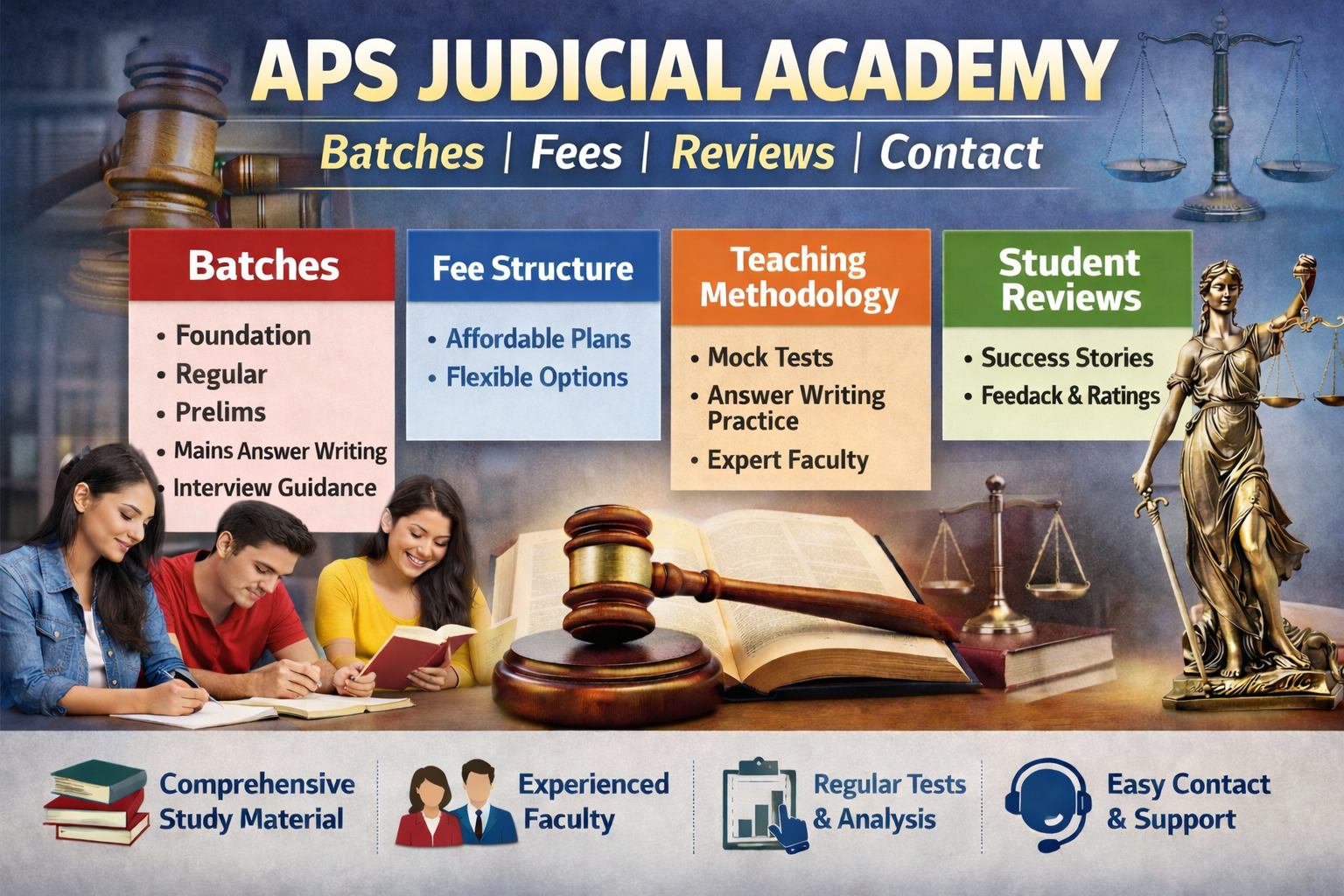
APS Judicial Academy has emerged as a dedicated platform for judicial services preparation, focusing on building strong legal fundamentals, examination-oriented strategies, and consistent practice for Prelims, Mains, and Interview stages. The academy emphasizes clarity of concepts, systematic syllabus coverage, and continuous evaluation to help aspirants improve accuracy, speed, and legal articulation. This detailed article explores batches, fee structure, teaching methodology, faculty strength, study materials, student reviews, academic environment, and contact-related information in a comprehensive manner, while maintaining balanced usage of the keyphrase as requested.
Overview of Judicial Services Preparation
Judicial Services examinations test candidates on a wide range of subjects including constitutional law, civil procedure, criminal procedure, evidence law, contract law, torts, property law, family law, criminal law, jurisprudence, and local laws specific to the state. Aspirants must clear three major stages: Preliminary examination, Mains examination, and Viva Voce or Interview. Each stage requires a distinct preparation approach.
A coaching institute dedicated to judicial services focuses on structured syllabus completion, regular testing, answer writing practice, case law updates, and personality development for interviews. The academy discussed in this article follows a comprehensive approach that aligns academic teaching with examination trends, enabling aspirants to prepare in a focused and disciplined manner.
Batches and Course Structure
Foundation Batches for Judicial Services
Foundation batches are designed for law students and recent graduates who wish to begin their judicial services preparation early. These batches emphasize conceptual clarity and gradual development of legal understanding.
Target Audience
- Final year law students
- Recent law graduates
- Beginners in judicial services preparation
Duration
Usually 12 to 18 months.
Key Features
- Detailed coverage of core law subjects
- Concept-based teaching with illustrations
- Introduction to case law analysis
- Regular topic-wise assessments
- Early exposure to answer writing techniques
Foundation batches allow students to build confidence in legal subjects while adapting to the discipline required for competitive examinations.
Regular Judicial Services Batches
Regular batches are the most popular choice among serious aspirants preparing for upcoming judicial exams.
Target Audience
- Dedicated judicial services aspirants
- Law graduates preparing full-time
Duration
8 to 12 months.
Key Features
- Complete syllabus coverage for Prelims and Mains
- Integrated approach to objective and descriptive preparation
- Weekly tests and evaluations
- Structured answer writing practice
- Case law discussions and statutory interpretation
These batches are designed to maintain momentum and ensure syllabus completion within a defined timeframe.
Prelims-Focused Batches
Some aspirants prefer specialized batches focusing exclusively on the Preliminary examination stage.
Target Audience
- Candidates targeting upcoming prelims exams
- Repeat aspirants needing focused revision
Duration
3 to 5 months.
Key Features
- Objective question-solving techniques
- Extensive MCQ practice
- Mock tests based on latest exam patterns
- Time management strategies
- Elimination techniques for objective questions
Prelims batches help candidates improve speed, accuracy, and confidence for the screening stage.
Mains Answer Writing Batches
Mains examination demands analytical writing, clarity of expression, and structured answers supported by legal reasoning.
Target Audience
- Candidates who have cleared prelims
- Aspirants focusing on descriptive preparation
Duration
4 to 6 months.
Key Features
- Daily or weekly answer writing practice
- Evaluation by experienced faculty
- Model answers and improvement suggestions
- Case law integration techniques
- Legal drafting guidance
These batches focus on enhancing writing quality and presentation, which are critical for scoring well in Mains.
Interview Guidance Programs
The interview stage tests personality, legal awareness, and practical understanding.
Target Audience
- Candidates shortlisted for Viva Voce
Duration
1 to 2 months.
Key Features
- Mock interviews
- Personality assessment
- Current legal issues discussions
- Courtroom etiquette guidance
- Confidence-building sessions
Fee Structure (Indicative)
The fee structure varies depending on batch type, duration, and academic support included.
Foundation Batch Fees
Indicative range: INR 60,000 to INR 1,20,000.
Regular Judicial Services Batch Fees
Indicative range: INR 80,000 to INR 1,50,000.
Prelims-Focused Batch Fees
Indicative range: INR 25,000 to INR 45,000.
Mains Answer Writing Batch Fees
Indicative range: INR 30,000 to INR 60,000.
Interview Guidance Program Fees
Indicative range: INR 15,000 to INR 30,000.
Fee structures may include classroom teaching, study materials, test series, and evaluation support. Payment options and installment facilities may be available as per institute policy.
Teaching Methodology
The academic methodology emphasizes clarity, consistency, and exam relevance.
Conceptual Teaching Approach
Faculty members focus on explaining legal provisions with practical illustrations, landmark judgments, and recent legal developments. Emphasis is placed on understanding the rationale behind laws rather than rote memorization.
Integrated Prelims and Mains Preparation
Rather than treating prelims and mains separately, teaching integrates both objective and descriptive perspectives. This approach helps students retain concepts and apply them across exam stages.
Regular Testing and Evaluation
Frequent tests help track progress and identify weak areas. Detailed feedback enables students to correct mistakes and refine strategies.
Answer Writing Focus
Answer writing sessions are conducted systematically to improve structure, legal reasoning, and clarity of expression. Students are trained to write concise yet comprehensive answers within time limits.
Faculty and Academic Support
The faculty team typically comprises experienced judicial educators, practicing advocates, and subject matter experts. Their combined experience helps students gain both theoretical clarity and practical insight.
Faculty Strengths
- In-depth subject knowledge
- Exam-oriented teaching style
- Focus on conceptual clarity
- Accessibility for doubt resolution
Regular mentorship sessions allow students to discuss preparation strategies, time management, and stress management.
Study Materials and Resources
Printed and Digital Notes
Comprehensive notes are provided for all major law subjects. These notes are designed to align with judicial exam syllabi and include statutory provisions, case laws, and illustrations.
Case Law Compilations
Regularly updated case law materials help students stay current with recent judgments relevant to judicial exams.
Test Series and Practice Papers
Students receive access to topic-wise tests, full-length mock exams, and previous years’ question discussions.
Learning Environment and Discipline
A disciplined academic environment plays a crucial role in judicial exam preparation.
Classroom Infrastructure
Classrooms are designed to facilitate focused learning with adequate seating, teaching aids, and minimal distractions.
Peer Learning Culture
Interaction with fellow aspirants encourages discussion, doubt-sharing, and collective growth.
Academic Discipline
Strict schedules, attendance monitoring, and regular evaluations promote consistency and accountability among students.
Student Reviews and Feedback
Student feedback often highlights structured teaching, experienced faculty, and consistent testing as key strengths.
Positive Feedback Themes
- Strong focus on judicial exam patterns
- Concept clarity in major law subjects
- Regular answer writing practice
- Supportive academic environment
Areas for Improvement
- Some students may seek more personalized mentoring
- Batch sizes may affect individual attention
Overall, reviews suggest that consistent effort combined with institutional guidance leads to measurable improvement.
Admission Process
- Initial inquiry and counseling session
- Batch selection based on preparation level
- Registration and documentation
- Fee submission
- Orientation and commencement of classes
Contact Details Table
| Institute Name | Website | Gmail | Contact |
|---|---|---|---|
| APS Judicial Academy | https://apslaw.in/ | apsjudicialacademy@gmail.com | +91 8803288032 |
Frequently Asked Questions (FAQs)
Q1. Who should join judicial services coaching early?
Law students in their final years and recent graduates benefit from early preparation.
Q2. Is judicial services preparation suitable for working professionals?
Yes, with disciplined scheduling and appropriate batch selection.
Q3. Are prelims and mains prepared together?
Yes, integrated preparation helps retain concepts effectively.
Q4. How important is answer writing practice?
Answer writing is crucial for scoring well in Mains examinations.
Q5. Are mock tests aligned with actual exam patterns?
Mock tests are designed to reflect recent judicial exam trends.
Q6. Do students receive case law updates?
Yes, regular case law updates form part of the study materials.
Q7. Is interview guidance provided?
Dedicated interview preparation programs are available.
Q8. Can repeat aspirants benefit from coaching?
Repeat aspirants often benefit from structured revision and strategy refinement.
Q9. Are study materials updated regularly?
Materials are revised periodically to reflect legal developments.
Q10. What is the ideal duration for judicial services preparation?
Preparation duration varies, but most aspirants require 1 to 2 years of focused study.
